



Issue No. 002
Q2 2026
NorthStar Index — Q2 2026 (Issue 002)
Quarterly Insights on Construction Cost & Project Risk.
Selective pressure
Construction cost inflation moderated in Q2, but project cost risk did not.
Pressure eased - but it did not disappear
Q2 AVERAGE
5.2%
Average YoY movement across the six tracked materials.
CHANGE FROM Q1
-3.0 pts
Broad pressure moderated quarter over quarter.
UTILITY LEAD TIME SIGNAL
18-24 mo.
Potential transformer and service-upgrade procurement window.
The market is becoming more selective. Broad-based escalation is giving way to concentrated pressure in electrical infrastructure and metal-intensive systems.
The question is no longer “Are construction costs going up?” It is “Which parts of my project are still exposed?”
About the NorthStar Index: The NorthStar Index is NorthStar Estimating's quarterly publication on construction cost trends, project risk, and market conditions affecting the built environment. Rather than simply reporting price movements, the Index interprets what those movements mean for owners, architects, engineers, construction managers, and contractors making decisions today.
This is how we think at NorthStar.
Q2 AT A GLANCE
The market is not uniformly calmer
A lower average does not mean lower risk for every project. Scope, system and procurement strategy now matter more than a single escalation percentage.
A more targeted market
Across the six benchmark materials tracked by the NorthStar Index, average year-over-year movement moderated from approximately 8.2% in Q1 to 5.2% in Q2.
That improvement is real, but it should not be read as a universal reduction in project risk.
Lumber, concrete and reinforcing steel have begun to stabilize after several years of significant volatility. At the same time, copper, aluminum and electrical infrastructure remain exposed to pricing, procurement and schedule pressure.
The better question
Which parts of my project are still exposed?
Not every project carries the same material or procurement risk.
What it means
Q2 supports a more targeted approach to budgeting.
Projects with conventional architectural finishes, light wood framing or limited infrastructure work may not require aggressive escalation assumptions across the entire estimate.
Conversely, projects involving electrical service upgrades, major power distribution, healthcare infrastructure, laboratories, utility-intensive renovations or other metal-heavy systems continue to warrant additional attention.
For projects with extended design schedules or delayed procurement, the greatest risk is no longer broad market inflation. It is concentrated exposure within a handful of critical building systems.
NORTHSTAR PERSPECTIVE
Good estimating is no longer about applying a single escalation percentage. It's about understanding where project-specific risk exists.
CONVENTIONAL SCOPES
Normal monitoring
Architectural finishes, light framing and limited infrastructure.
METAL-INTENSIVE SCOPES
Validate early
Aluminum, copper, major feeders and distribution equipment.
LONG-LEAD SYSTEMS
Plan procurement
Transformers, switchgear, utilities and phased shutdowns.
WHAT WE'RE WATCHING
Electrical infrastructure is now a cost and schedule issue
Pricing remains elevated, but procurement timelines, utility coordination and phasing are increasingly shaping the budget.
Electrical infrastructure
Copper and aluminum continue to outperform the broader construction market, but pricing is only part of the story.
Procurement timelines for utility transformers, switchgear and associated service upgrades are increasingly affecting project schedules. During a recent institutional project, the electrical engineer advised that procurement and installation of a new utility transformer and service upgrade could require 18 to 24 months.
Lead times vary by utility, equipment type and region. The broader message is clear: electrical infrastructure is becoming both a cost risk and a schedule risk.
18-24
MONTHS
Potential procurement and installation window cited for a utility transformer and service upgrade.
01
Define early
Confirm service size, feeder routes, equipment ratings and utility requirements before the design hardens.
02
Coordinate utilities
Treat utility review, temporary service and shutdown planning as core design inputs.
03
Plan procurement
Evaluate early release, approved manufacturers, substitutions and phasing before CDs are complete.
Infrastructure & renovation
Existing-condition work continues to present greater uncertainty than new construction. Utility relocations, concealed conditions, phasing and operational shutdowns remain among the most significant drivers of cost growth.
Design timing
Material escalation is becoming increasingly project-specific. Early cost modeling and scope validation remain the most effective tools for protecting budgets before Construction Documents are complete.
BY THE NUMBERS
Pressure is concentrated in a smaller set of materials
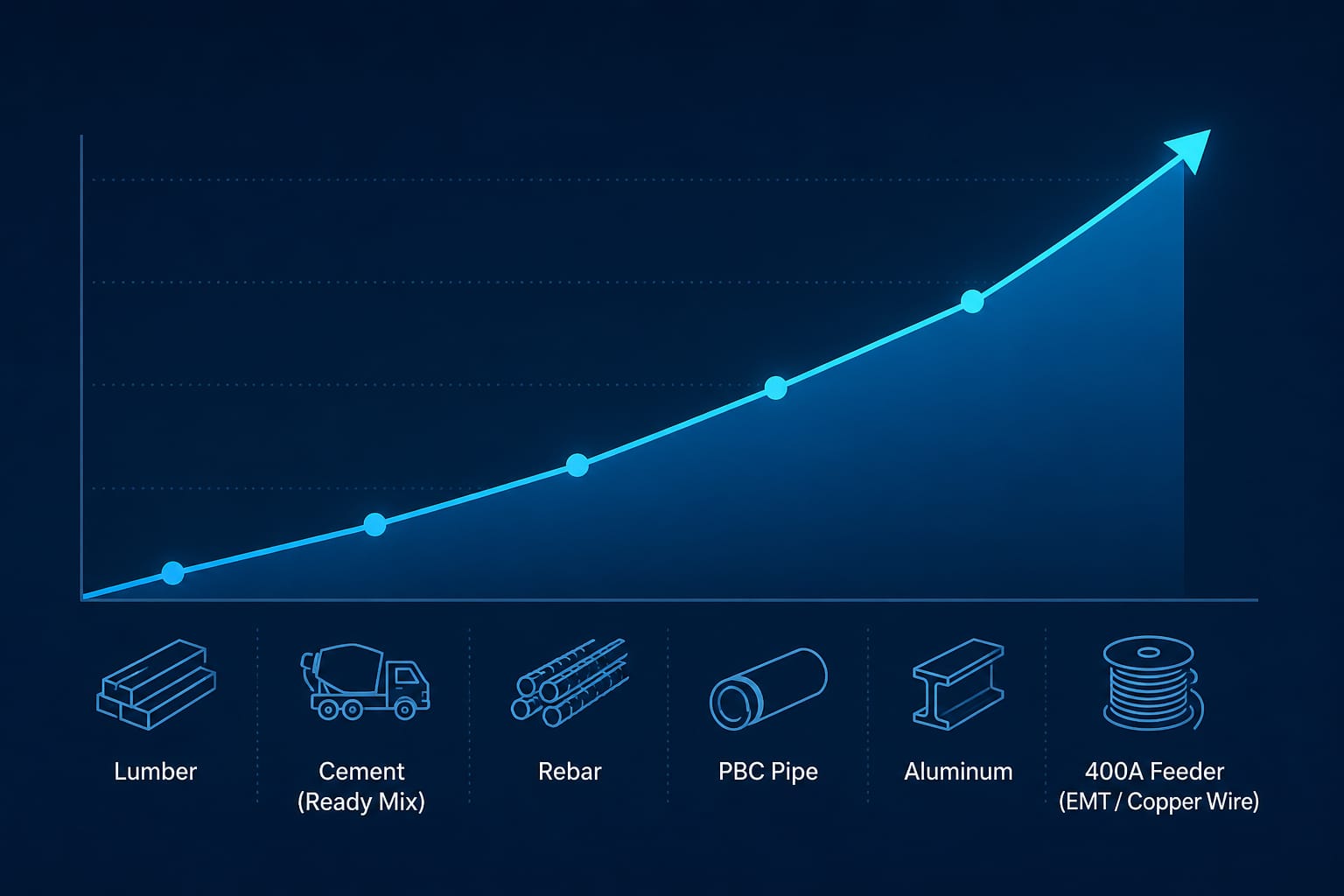
Aluminum and copper-related systems remain the strongest areas of exposure. Lumber, PVC and concrete inputs are showing more measured movement.
Sources: publicly available producer-price data; construction market reporting; supplier intelligence; contractor feedback; NorthStar Estimating review of bid activity. Values are planning indicators, not project-specific pricing.
Lumber
+3.0% YoY
Pricing continued to moderate during Q2, indicating improved market stability.
NorthStar Perspective: Continue normal monitoring.
Cement / ready-mix
+2.0% YoY
Concrete pricing remains elevated but continued to slow during the quarter.
NorthStar Perspective: Validate pricing regionally and apply standard escalation.
Rebar
+5.5% YoY
Reinforcing steel remains influenced by import markets and tariff sensitivity despite easing from Q1.
NorthStar Perspective: Monitor on concrete-intensive and infrastructure projects.
PVC pipe
+3.0% YoY
PVC pricing rebounded modestly following a relatively flat first quarter.
NorthStar Perspective: Standard contingency remains appropriate for most projects.
Aluminum
+10.0% YoY
Pricing remains elevated amid energy costs, manufacturing constraints and tariff exposure.
NorthStar Perspective: Validate quantities early and avoid generic allowances.
400A feeder / copper
+7.5% YoY
Copper-related electrical components remain one of the most significant cost drivers across institutional projects.
NorthStar Perspective: Prioritize scope definition, procurement planning and utility coordination.
NORTHSTAR INSIGHT
The practical response is trade-specific
Review contingency, scope and procurement by package. The average matters less when one critical system can move the entire budget or schedule.
ONE QUESTION WORTH ASKING
If you removed a single escalation percentage and evaluated risk by trade package, would your budget change?
For many projects this quarter, the answer is yes.
FOR OWNERS
Review contingency by trade package, not by overall project.
FOR ARCHITECTS
Identify infrastructure-intensive scopes early enough to evaluate alternatives before the design becomes fixed.
FOR CONSTRUCTION MANAGERS
Engage key electrical and metal-intensive trades early to validate pricing and procurement strategy.
Methodology
The NorthStar Index tracks six benchmark construction materials that consistently influence institutional and public-sector project budgets. Each material is indexed to 100 at Q1 2021 and equally weighted within the composite index.
Material movements are informed by publicly available producer-price data, construction market reporting, supplier intelligence, contractor feedback and NorthStar Estimating's ongoing review of bid activity across the markets we serve.
The Index is intended as a planning and budgeting tool. Project-specific estimates should reflect scope, location, schedule, procurement strategy, and prevailing market conditions.
How to use the index
The NorthStar Index is a planning and budgeting tool. Project-specific estimates should reflect scope, procurement strategy, schedule, location and prevailing market conditions.
No general index replaces trade-level quantity validation, local market testing or a project-specific estimate.
Good estimating is not about reacting to the market. It is about understanding which parts of the market matter to your project.
This is how we think at NorthStar.
NorthStar
Estimating, Inc.
northstarestimating.com