


The Difference Between Cost Accuracy and Cost Certainty
By NorthStar EstimatingSeptember 17, 2026
A cost estimator's perspective on the question behind the question. Lessons from the estimating table: where experience, judgment, and construction costs intersect.
There is a question that comes up on almost every project sooner or later:
"How confident are you in this number?"
It sounds like a question about accuracy.
Usually, it is a question about certainty.
And those are not the same thing.
An estimate can be well developed, thoughtfully priced, and entirely appropriate for the information available while still carrying meaningful uncertainty. That does not make it a bad estimate.
It means the project is still developing.
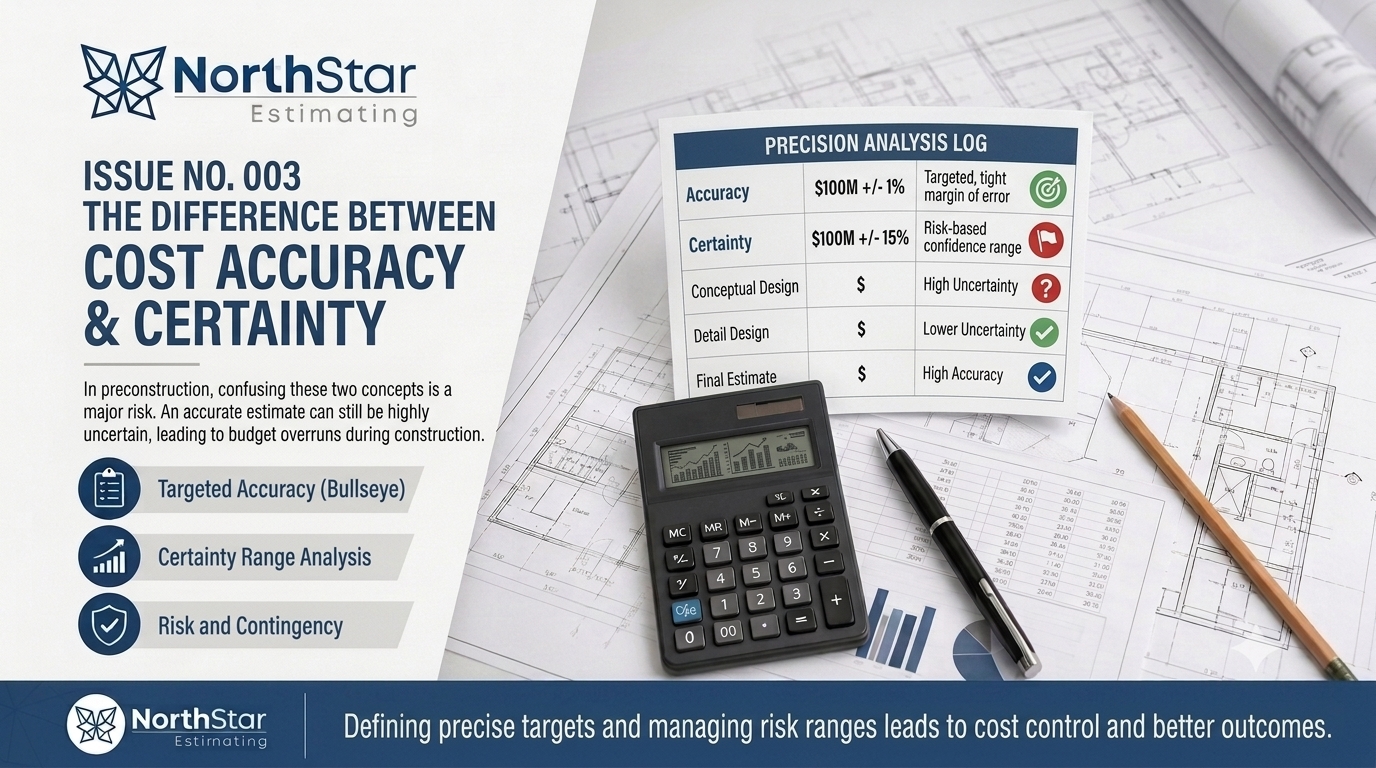
Accuracy asks: how closely does the estimate reflect the probable cost of the work?
Certainty asks: how much do we actually know about the work being estimated?
Those two ideas are related, but they are not interchangeable.
At an early design stage, the estimator may understand the project well enough to establish a reasonable budget. But many of the decisions that ultimately determine cost may still be unresolved.
- What structural system will be used?
- How will the building envelope be detailed?
- What equipment will actually be selected?
- How extensive are the existing conditions?
- What will the phasing require?
- How will utilities be routed?
- What finish level is intended?
Those questions do not necessarily prevent us from developing an estimate. They affect how much certainty should be attached to it.
That distinction matters, because one of the greatest risks in early cost planning is not an inaccurate estimate.
It is false certainty.
A number can look more certain than it is
Estimates are full of precise numbers.
$14,862,417 looks very specific.
But the number of digits does not tell you how developed the design is.
A schematic estimate may contain thousands of individual calculations, quantities, assumptions, allowances, and unit costs. The arithmetic can be extremely precise while the underlying scope is still evolving.
That is why we are careful not to confuse precision with certainty.
Sometimes $14.9 million is a more honest way to communicate the project than $14,862,417.
The estimate may mathematically produce the second number. The project may only support the first.
Good estimating makes uncertainty visible
Eliminating uncertainty is not the estimator's job. At certain stages of design, that is impossible.
The job is to identify it.
A good estimate should help the project team understand what is known, what has been assumed, what has been allowed for, what remains unresolved, and which of those unresolved items could materially affect the budget.
That is why the Basis of Estimate is so important.
The assumptions are not fine print attached to the number. They are part of the number.
If a conceptual estimate assumes a conventional structural system and the design later moves toward long spans, complex transfers, or specialty framing, the estimate did not necessarily "miss." The scope changed.
If an early renovation budget assumes limited utility modifications and investigation later reveals extensive service upgrades, the original estimate may have been completely reasonable based on what was known at the time. New information changed the cost picture.
Understanding that distinction allows project teams to manage the budget without turning every change into a debate over whether the previous estimate was right or wrong.
Cost certainty should grow with the design
As a project develops, uncertainty should begin to disappear.
At conceptual design, we may rely heavily on benchmarking, program information, allowances, and experience.
At schematic design, building systems, quantities, and major materials begin to take shape.
During design development, assumptions should increasingly become measurable scope.
By construction documents, most significant cost drivers should be identifiable and quantifiable.
The estimate should evolve with that progression — not simply by updating prices, but by replacing assumptions with information.
That is one of the most important differences between updating an estimate and developing an estimate.
The goal at each milestone is not merely to produce another number. It is to reduce the amount of uncertainty inside that number.
The NorthStar perspective
When we present an estimate, we have found the most useful conversation is rarely "Is this number right?"
A better conversation is: "What would have to change for this number to change?"
That question tells us much more about the health of the budget.
If the major systems are defined, quantities are developed, existing conditions are understood, and procurement assumptions are established, the estimate may carry relatively high certainty.
If major decisions remain open, the project team should understand where that exposure sits.
That does not mean adding contingency everywhere. Contingency has a role, but it is not a substitute for understanding the scope.
Sometimes the right response is additional investigation. Sometimes it is design development. Sometimes it is an allowance. Sometimes it is an alternate. Sometimes it is simply documenting the assumption and watching it as the project develops.
The important thing is that the uncertainty is visible.
Questions worth asking
When reviewing an estimate, project teams should ask:
- Which parts of the estimate are based on developed scope, and which are based on assumptions?
- Where are the largest allowances?
- What information could materially change the estimate at the next milestone?
- Which existing conditions have not yet been verified?
- Are major systems actually selected, or are they still placeholders?
- Does the contingency reflect genuine uncertainty, or is it covering scope we simply have not defined yet?
- What should become more certain before the next estimate?
Those questions turn the estimate from a static number into a tool for managing the design.
The takeaway
Project teams naturally want certainty. Owners need budgets. Designers need targets. Funding decisions need numbers.
Responsible estimating means recognizing that certainty is earned as information develops.
A good early estimate does not pretend to know everything. It establishes a reasonable cost position, documents what is known, identifies what is not, and gives the team a path toward greater certainty.
An estimate should never make an uncertain project look certain. Its purpose is to help the team understand where the uncertainty sits and what to do about it.
This is how we think at NorthStar.
Inside the Estimate is a series from NorthStar Estimating exploring the decisions and conversations that shape project costs long before construction begins. Each issue offers practical insights for owners, architects, engineers, and construction professionals seeking to make better informed decisions.