


When Is a Change Order Really a Change?
By NorthStar EstimatingJuly 27, 2026
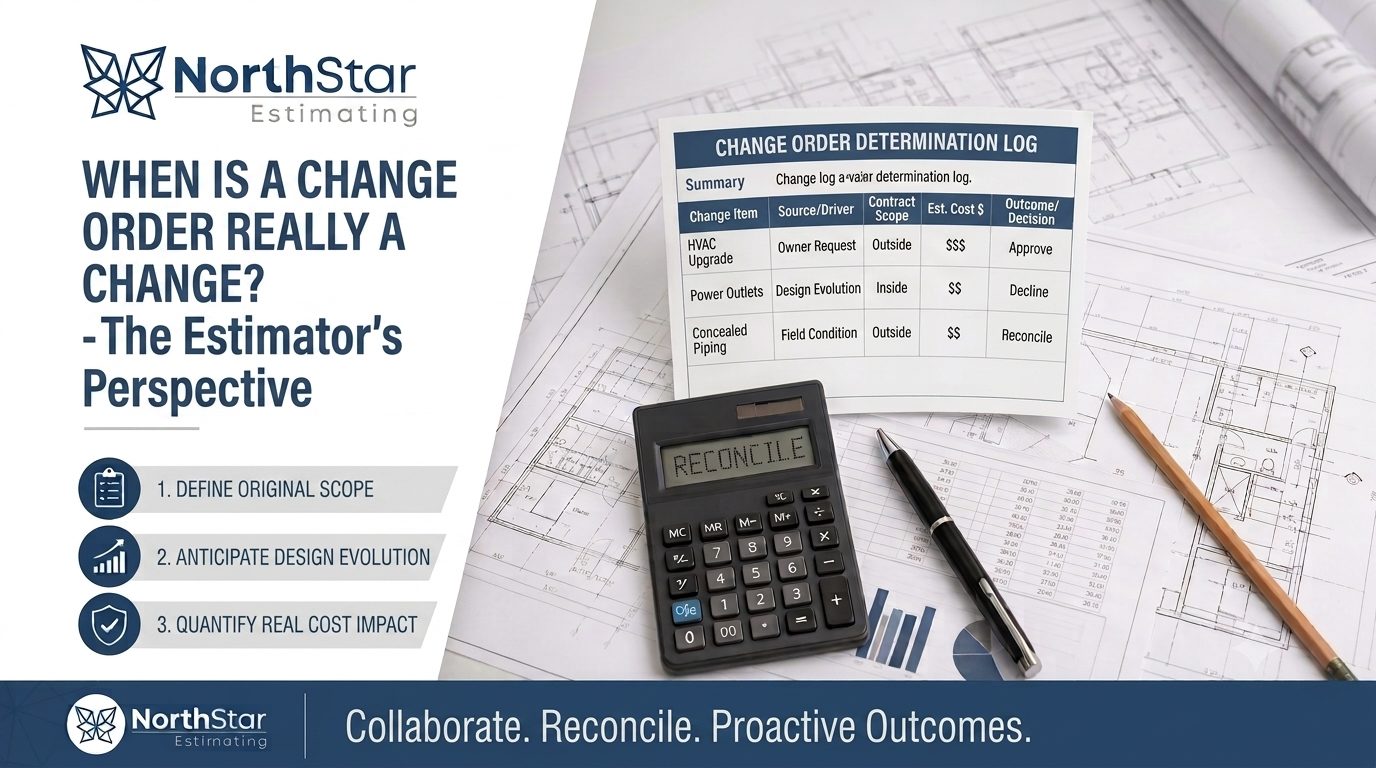
A Cost Estimator's Perspective on One of Construction's Most Misunderstood Topics. Lessons from the estimating table — where experience, judgment, and construction costs intersect.
Construction projects evolve. Drawings are refined, existing conditions are uncovered, code officials request revisions, and owners adjust priorities. Change is expected.
The difficult part isn't recognizing that something has changed.
It's determining whether that change actually justifies additional compensation.
After participating in hundreds of change order reviews across healthcare, education, civic, and commercial projects, we've found that most disputes don't begin with pricing, they begin with scope.
The first question shouldn't be:
"How much does this change cost?"
The first question should be:
"Was this work already required?"
That distinction can save owners hundreds of thousands of dollars while ensuring contractors are fairly compensated for legitimate additional work.
Not Every Additional Cost Is a Change Order
One of the most common misconceptions in construction is that any additional effort automatically becomes a change order.
In reality, many added costs stem from work that was already included in the contract documents.
Examples include:
- Work required by the drawings but overlooked during construction
- Code-required work already shown, specified, or reasonably required by the original documents
- Coordination between trades
- Means and methods selected by the contractor
- Rework resulting from installation errors
These situations may increase the contractor's effort, but they do not necessarily increase the owner's contractual responsibility.
Conversely, legitimate change orders often arise from circumstances that truly alter the project's scope, such as:
- Owner-directed scope revisions
- Regulatory agency comments issued after design completion
- Previously concealed existing conditions
- Design revisions that materially change the work
- Differing site conditions that could not reasonably have been anticipated
The challenge is separating one from the other.
Price Comes Second
One of the biggest mistakes we see is jumping immediately into pricing.
Before labor hours, equipment, markups, or overhead are discussed, the project team should establish a shared understanding of one question:
What changed?
That conversation often requires reviewing:
- Contract drawings
- Specifications
- RFIs and responses
- Bulletin drawings
- Meeting minutes
- Existing-condition documentation
- Field photographs
- Code review comments
Only after the scope is clearly understood does pricing become meaningful.
Otherwise, teams end up negotiating numbers instead of facts.
Documentation Matters More Than Opinions
A well-supported change order rarely depends on who argues the loudest.
It depends on documentation.
Some of the strongest change order evaluations we've participated in included:
- Before-and-after drawings clearly illustrating the revision
- Field photographs documenting concealed conditions
- Marked-up plans identifying affected areas
- RFIs showing how the work evolved
- Narrative explanations connecting the change to the additional work
- Quantity takeoffs supporting labor and material impacts
The stronger the documentation, the easier it becomes to separate legitimate changes from contractual obligations.
Independent Cost Review Changes the Conversation
An independent estimator brings something unique to the process.
Unlike the owner, contractor, or designer, an independent estimator has no financial interest in the contractor's markup, fee, or final change order value.
The role isn't to advocate for one side.
It's to answer questions objectively:
- Is the work actually new?
- Does the requested scope appear reasonable?
- Are the quantities supported?
- Is the pricing consistent with market conditions?
- Have markups been applied appropriately?
- Are there scope gaps or duplicated costs?
That independent perspective often transforms emotional negotiations into fact-based discussions.
Our Approach at NorthStar
Every change order review begins with scope, not dollars.
We first determine whether the requested work represents a legitimate change to the contract. Once that foundation is established, we evaluate quantities, labor assumptions, material costs, equipment, subcontractor proposals, productivity impacts, markups, and supporting documentation.
Sometimes our review validates the contractor's request.
Sometimes it identifies scope that was already included.
Sometimes it finds legitimate costs that neither party initially recognized.
In every case, the objective is the same:
Help owners make informed decisions while ensuring contractors are fairly compensated for work that truly falls outside the original contract.
The NorthStar Perspective
Good change order reviews aren't about finding reasons to say "yes."
They're not about finding reasons to say "no."
They're about helping project teams make decisions they can defend.
Because a change order isn't simply a price.
It's a decision about scope.
A decision about responsibility.
A decision about risk.
When those decisions are grounded in documentation, technical judgment, and objective analysis, projects move forward with greater confidence, and with far fewer disputes.
At NorthStar Estimating, we believe good estimating isn't about predicting the future. It's about helping project teams make better decisions before they become expensive. This is how NorthStar thinks about construction costs.
Inside the Estimate is a series from NorthStar Estimating exploring the decisions, risks, and conversations that shape project costs long before construction begins. Drawing from real projects and more than two decades of experience, each article offers practical insights for owners, architects, engineers, and construction professionals seeking to make better-informed decisions.