


Why Every Estimate Is Also a Scope Review
By NorthStar EstimatingAugust 27, 2026
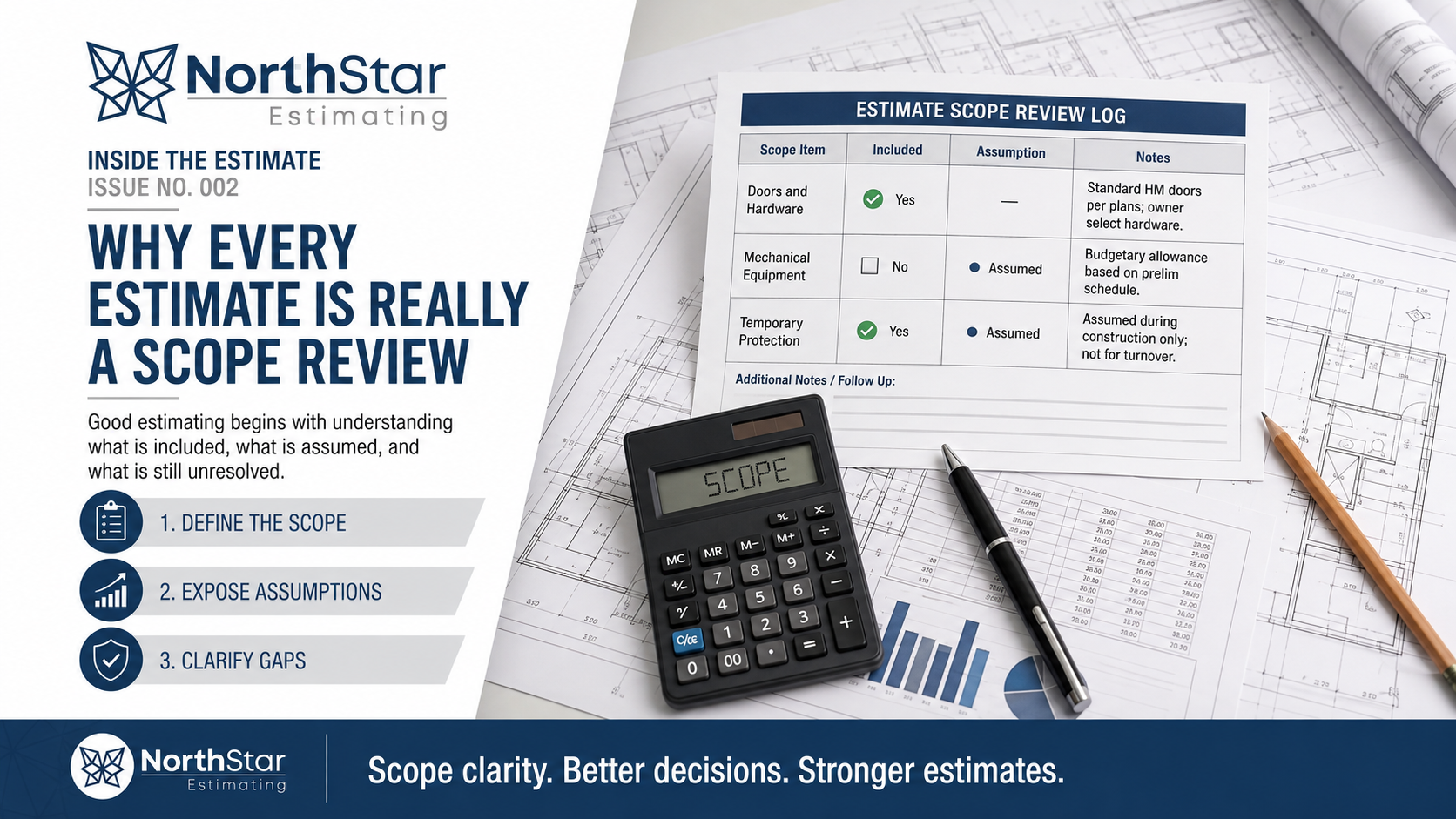
A cost estimator's perspective on what an estimate is doing long before it produces a total. Lessons from the estimating table — where experience, judgment, and construction costs intersect.
There is a familiar moment in almost every estimate review.
The estimate is on the screen. The total is higher than expected.
Someone asks: "Why did the cost go up?"
The natural reaction is to start looking at the numbers. Are the unit costs too high? Did labor or material prices change? Is there too much contingency?
Those are reasonable questions.
But often, something else is happening.
A system that was previously carried as an allowance is now defined. A finish has been added. A piece of equipment now requires power, controls, structural support, or associated repairs. A renovation that looked simple now includes demolition, protection, phasing, and restoration.
The cost changed because our understanding of the project changed.
That is the point where the estimate stops being a calculation and becomes a scope review. An estimate forces the project team's understanding of scope to become explicit.
What are we actually pricing?
Every estimate has to answer one question before any cost can be assigned:
What are we actually pricing?
That sounds simple. It rarely is.
An estimator has to interpret what is shown, what is implied, what has changed, what is still undecided, and what will be required to make the work complete.
At an early phase, that may mean filling in gaps where the design is still developing. Later, it may mean comparing drawings, specifications, narratives, and schedules to determine whether they all describe the same project.
In both cases, the estimate is doing more than measuring quantities. It is testing the team's understanding of scope.
That is also why two qualified estimators can review the same project, use reasonable unit costs, and arrive at different totals. Sometimes the difference has less to do with what they think the work costs and more to do with what they believe the work includes.
What does the number include?
Consider a simple example.
One estimate carries $800 for a door. Another carries $900.
It is easy to focus on the $100 difference.
But what does each number include?
- The door?
- The frame?
- Hardware?
- Access control?
- Power?
- Patching and painting?
If one estimate includes those items and the other does not, the unit cost is no longer the real issue. The issue is scope.
The same principle applies throughout an estimate. Behind every quantity, allowance, unit cost, and contingency is an assumption about what the project requires.
So when a number looks high or low, one of the first questions should be: "What does this number include?"
Estimates reveal what is still uncertain
A good estimate should also make uncertainty visible.
Maybe a material has not been selected. Maybe the mechanical system is still being evaluated. Maybe existing conditions are not fully understood. Maybe a utility requirement is still being confirmed.
None of that means the project cannot be estimated. It means the estimate needs to clearly identify the assumptions being made.
In our experience, allowances, assumptions, and exclusions belong in the body of the story the estimate is telling. They show what is defined and what is still developing. They also show where a future decision could move the budget.
The gaps often live between disciplines
Some of the most important scope questions do not sit neatly on one drawing. They sit between disciplines.
- Who provides power to the equipment?
- Who provides the structural support?
- Who carries the controls?
- Who repairs what has to be opened to install the work?
- Who provides temporary service during construction?
Each question may appear small. Across a project, those interfaces can become significant.
Because an estimate has to bring architecture, structure, MEP systems, site work, equipment, phasing, and general conditions into one cost model, it often exposes gaps that are difficult to see when each discipline is reviewed separately.
We think that is one of the most valuable things an estimate can do.
The NorthStar perspective
We do not think an estimate review should be about defending numbers. It should be about understanding them.
If someone questions a cost, the strongest response is not "that is our number."
It is: "Here is what we carried, and here is why."
Show the quantity. Show the drawing. Show the assumption. Show the scope. Then decide whether the interpretation is right.
Sometimes that conversation changes the estimate. That is exactly what should happen. As the team's understanding of the project improves, the estimate should improve with it.
The goal is to understand the project well enough that the spreadsheet can be defended.
Questions worth asking
When reviewing an estimate, ask:
- What assumptions were required to complete the estimate?
- Where are scope gaps, overlaps, or unresolved decisions still affecting the budget?
- If two estimates differ, are we comparing prices, or are we comparing scope?
Before an estimate can tell you what a project costs, it has to tell you what the project is.
This is how we think at NorthStar.
Inside the Estimate is a series from NorthStar Estimating exploring the decisions and conversations that shape project costs long before construction begins. Each issue offers practical insights for owners, architects, engineers, and construction professionals seeking to make better informed decisions.